Duy Tan University
Faculty of Nursing
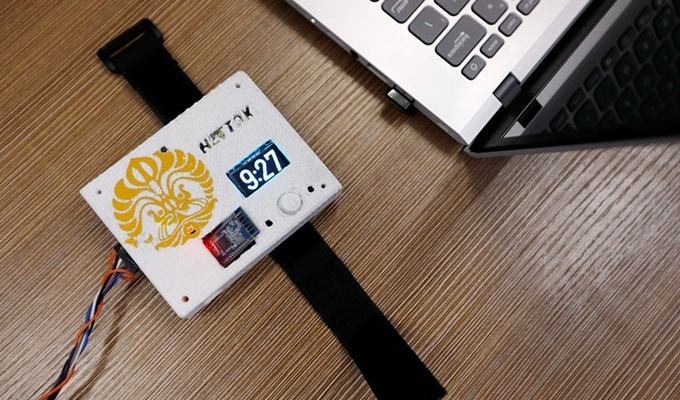
Research, Design, and Fabrication of a Handheld Parking Ticket Dispenser Using RFID Technology
Posted On: 26/01/2021
Prior to using this compact management device, security personnel at companies, enterprises, and hospitals in Da Nang managed incoming and outgoing vehicles (bicycles, motorbikes, cars, etc.) entirely through manual methods (writing cards, tearing tickets, punching cards, etc.). These methods often caused frustration for vehicle owners due to chalk markings left on their vehicles. Alternatively, some facilities set up two ticket-issuing and receiving stations utilizing supporting hardware such as computers, cameras, and magnetic card readers. Although this approach reduced processing time compared to purely manual labor, high installation, maintenance, and repair costs for multiple electronic devices increased operational expenses. Additionally, the challenge of relocating equipment when moving facilities or altering parking lot layouts presented significant operational drawbacks.
Under the conventional, purely manual vehicle management process, when a vehicle arrives, the security staff writes or tears a ticket, attaches one part to the vehicle, and hands the matching ticket to the driver. Facilities employing a semi-automated process require several steps: asking the driver to stop at the designated stop line ("STOP"), observing the license plate image captured by the camera on a computer screen, and verifying the license plate information. If the recognized license plate matches the captured image, the staff swipes the card, hands it to the driver, and grants entry.
When a vehicle exits under the manual method, security guards match the ticket number provided by the driver with the ticket attached to the vehicle. If the numbers match without signs of alteration or tearing, the guards retrieve both tickets, discard them, and allow the vehicle to leave. Under the semi-automated method, drivers are instructed to pull up to the stop line ("STOP"). Guards observe the screen to ensure a clear view of the license plate image, swipe the card, and check the license plate details on the screen. If the camera image matches the card data, the card is validated and collected. However, drivers must often adjust their vehicle's position so the camera can capture a clear plate image and wait for the computer to process the correct license plate number. This creates inconvenience for both the driver and the computer processing system, not to mention that weather conditions (sun, rain, wind, etc.) and the station location significantly affect the performance of sensitive electronic equipment.
Recognizing these challenges, alongside the rapid development of electrical engineering, electronics, and telecommunications—and building on Duy Tan University's more than 20-year history, particularly noting the recent increase in student enrollment and subsequent parking management issues—we propose a solution to research, design, and manufacture a handheld RFID-based parking ticket dispenser. This device aims to minimize vehicle turnaround time, reduce installation and management costs, enhance parking lot management efficiency across organizations, and elevate Da Nang's image as a "Liveable City," contributing to its strong position as an urban center applying technology to tourism and national international economic integration.
Other News
- Research, Design, and Development of an Embedded Security Control Device Integrating a Camera, Display, Fingerprint Scanner, and RFID Card Reader
- Duy Tan University's 2015 creative entry
- Research, Design, and Fabrication of an Automatic Drainage Gauze Folding and Rolling Machine
- Research, Design, and Fabrication of Experimental Teaching Equipment for Determining the Center of Hydrostatic Pressure on a Flat Surface
- Research, Design, and Fabrication of a Wireless Electronic Queue Ticket Dispensing System