Duy Tan University
Faculty of Nursing
Aquaponics Model: Combining Fish Farming with Hydroponics
Posted On: 13/09/2024
A group of 4th-year students from the Faculty of Automation at the Vietnam National Academy of Agriculture successfully designed and introduced an automated aquaponics system combining fish farming and hydroponic vegetable cultivation. The model was showcased in the "Proud of Vietnamese Innovation" exhibition area at the International Automation Exhibition 2019. Developed over the course of a year by four team members, the system applies IoT (Internet of Things) technology for parameter monitoring and automated control.
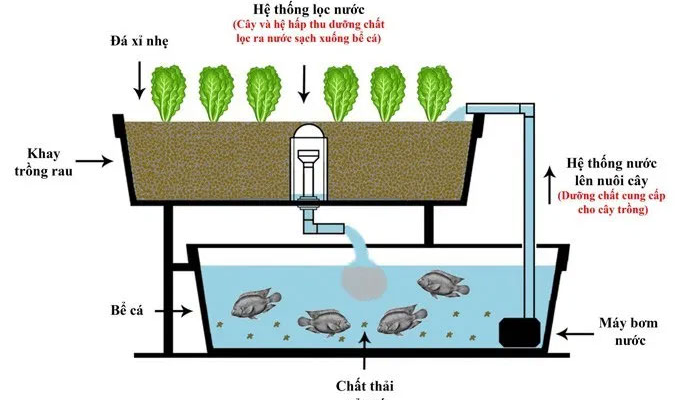
The system consists of a plant growing bed, a fish tank, a water filtration system, and automated monitoring software. Water from the fish tank—containing fish waste, ammonia, and nitrifying bacteria—is filtered and converted into nitrates before being pumped up to the plant bed. After absorbing the nutrients, the plants filter the water clean and recirculate it back down to the fish tank. As a result, the plants receive essential nutrients to grow, and the fish receive clean water to thrive without requiring manual watering or water filtration.
The model combining fish farming and hydroponic vegetable cultivation. (Photo: Provided by the subjects)
Project leader Nguyen Van Thanh shared that the model operates on a symbiotic mechanism, leveraging the mutual benefits of plants and fish without requiring soil, fertilizers, or manual watering. The key innovation of this model lies in integrating IoT technology to monitor environmental parameters and automate control processes.
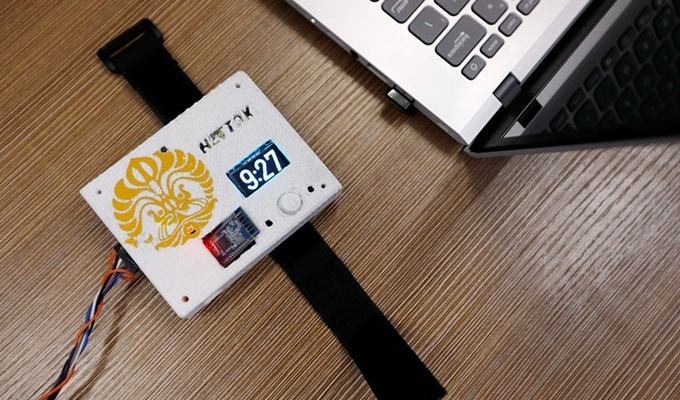
"We researched and sought guidance from our teachers and engineers to create a sensor system placed in both the fish tank and the vegetable garden. These sensors update real-time parameters including temperature, dissolved oxygen levels, and humidity. Users simply connect the sensor system to their smartphones. If any parameter exceeds the allowable threshold, the system immediately sends an alert to the user's phone, enabling remote observation of both crop and fish growth," explained student Nguyen Van Thanh.
Currently, the team is working to optimize the system by utilizing solar panels to generate power for operation. "Once the technical aspects are fully refined, we stand ready to transfer this technology to interested households and enterprises," Thanh added.